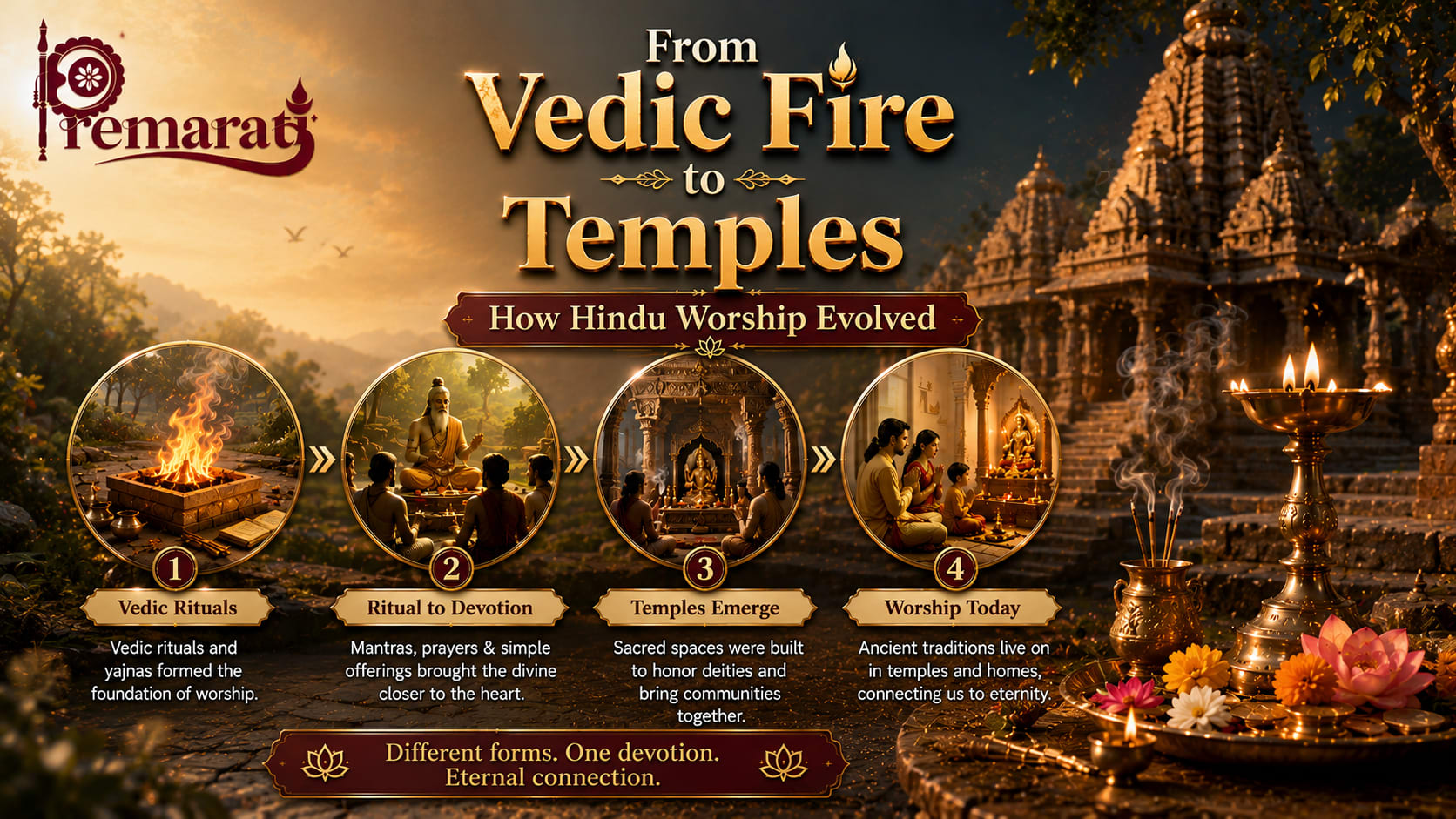
Hindu worship began with Vedic fire rituals centred on Agni, mantras and offerings, then gradually grew to include murti puja, home shrines and temple worship. This guide traces that journey, shows how Vedic elements live on in aarti, lamps and homa, and explains how families keep the tradition alive today.
A Tradition of Continuity and Change
Hindu worship has travelled a long road, from the sacred fire of the Vedic age to the lamp-lit sanctum of a temple. Early Vedic fire rituals centred on Agni, hymns and offerings. Temple worship, which grew in importance over later centuries, centres on consecrated images (murtis), regular worship, offerings and darshan.
This was not an overnight change. It was a gradual process of adaptation and blending, and many Vedic elements are still visible in worship today.
Vedic Fire Rituals: Worship Centred on Agni
The Role of Agni, the Sacred Fire
In early Vedic rites, fire (Agni) was the heart of worship. Offerings were placed into the fire while priests chanted mantras and hymns. Agni was understood as the link between worshippers and the deities, carrying offerings from the human world to the divine.
Yajna and Homa: Elaborate and Precise Ceremonies
Vedic ceremonies could be elaborate, involving several fires, specialised priests and precise procedures. Alongside these larger rites, householders performed simpler domestic rituals with offerings, fire rites and life-cycle ceremonies at home. In this way, the sacred fire became a symbolic medium through which devotion was expressed.
From Fire to Images: The Rise of Murti Puja
A Gradual Shift, Not a Sudden One
Over the centuries, Hindu worship became more varied. Worship of deities through sacred images developed through domestic ritual practices, Puranic traditions and Agamic systems. Scholars who study the history of puja describe this as a gradual change, with Vedic ritual and family ceremony influencing one another.
The Murti as a Focus of Devotion
The murti became a vital focus of worship. Devotees honoured it with mantras, flowers, lamps, incense, food and other offerings, the same elements many families still use in their home mandirs today.
The Emergence of Temple Worship
From Temporary Altars to Permanent Sacred Spaces
During the first millennium CE, image-centred worship and temple building grew in importance. Instead of gathering around a temporary fire altar, devotees could visit a permanent temple, see the deity (darshan), take part in puja and receive prasad.
The Sanctum and Daily Worship
At the heart of the temple is the sanctum, where devotees worship the deity through regular rituals according to the temple’s tradition. This gave worship a lasting home and made it accessible to the wider community.
How Vedic Rituals Live On in Temple Traditions
Very little in this evolution was entirely new. Traces of the Vedic past can be found in later traditions. Studies of the history of puja show how older ritual practices were adapted, and in some traditions fire elements such as hawan were added to image worship.
Vedic and temple traditions therefore grew side by side as parts of one continuing tradition, not as rivals.
A Braided Tradition: Hindu Worship Today
Today, Hindu worship weaves together many streams. A temple ceremony may include mantras, aarti, lamps, incense, flowers, food offerings and, in some contexts, hawan or yajna.
Elements You Will Still Find in Worship Today
Mantras: Sacred chants with roots in Vedic tradition
Lamps and aarti: Light offered to the deity
Incense and flowers: Offerings of fragrance and beauty
Naivedya and prasad: Food offered and shared with devotion
Homa or yajna: Fire rituals, performed in some traditions and on special occasions
This continuity shows how Hindu practice has changed over time while keeping older ideas of offering, sacred space and the presence of the divine.
Bringing Tradition Home With Premarati
In the modern age, families keep these traditions alive by preparing for rituals with care. Premarati supports home worship, festivals and devotional occasions by offering the puja essentials you need, from diyas and incense to flowers, offerings and puja thalis, so you can focus on the spirit of the ritual.
Simple Puja Essentials for Your Home Mandir
Diya, cotton wicks and ghee or oil
Incense sticks and camphor
Fresh flowers and a puja thali
Kumkum, roli and akshat
A bell for aarti
Even a small corner with a clean shelf, a lit diya and a few flowers carries the same spirit of offering that began at the Vedic fire.
Frequently Asked Questions
What is the difference between Vedic fire rituals and temple worship?
Vedic rituals centred on offerings into the sacred fire, with priests chanting mantras. Temple worship centres on a consecrated murti in a permanent sacred space, with daily worship, darshan and prasad.
Did Hindu worship change suddenly from fire rituals to temples?
No. Scholars describe it as a gradual evolution, shaped by domestic rituals, Puranic traditions and Agamic systems.
Are fire rituals still part of Hindu worship?
Yes. Many traditions still perform hawan and yajna, and lamps and aarti carry fire's symbolism into daily worship.
A Living Spiritual Journey
From Agni to the murti, and from the Vedic fire altar to the temple sanctum, Hindu worship is a story of continuity and change. Shaped over many centuries by ritual innovation, adaptation and bhakti, it remains a living tradition that still brings families and communities together.
Keep the sacred flame of tradition alive with Premarati, bringing every puja essential you need to your home, from diya to thali.