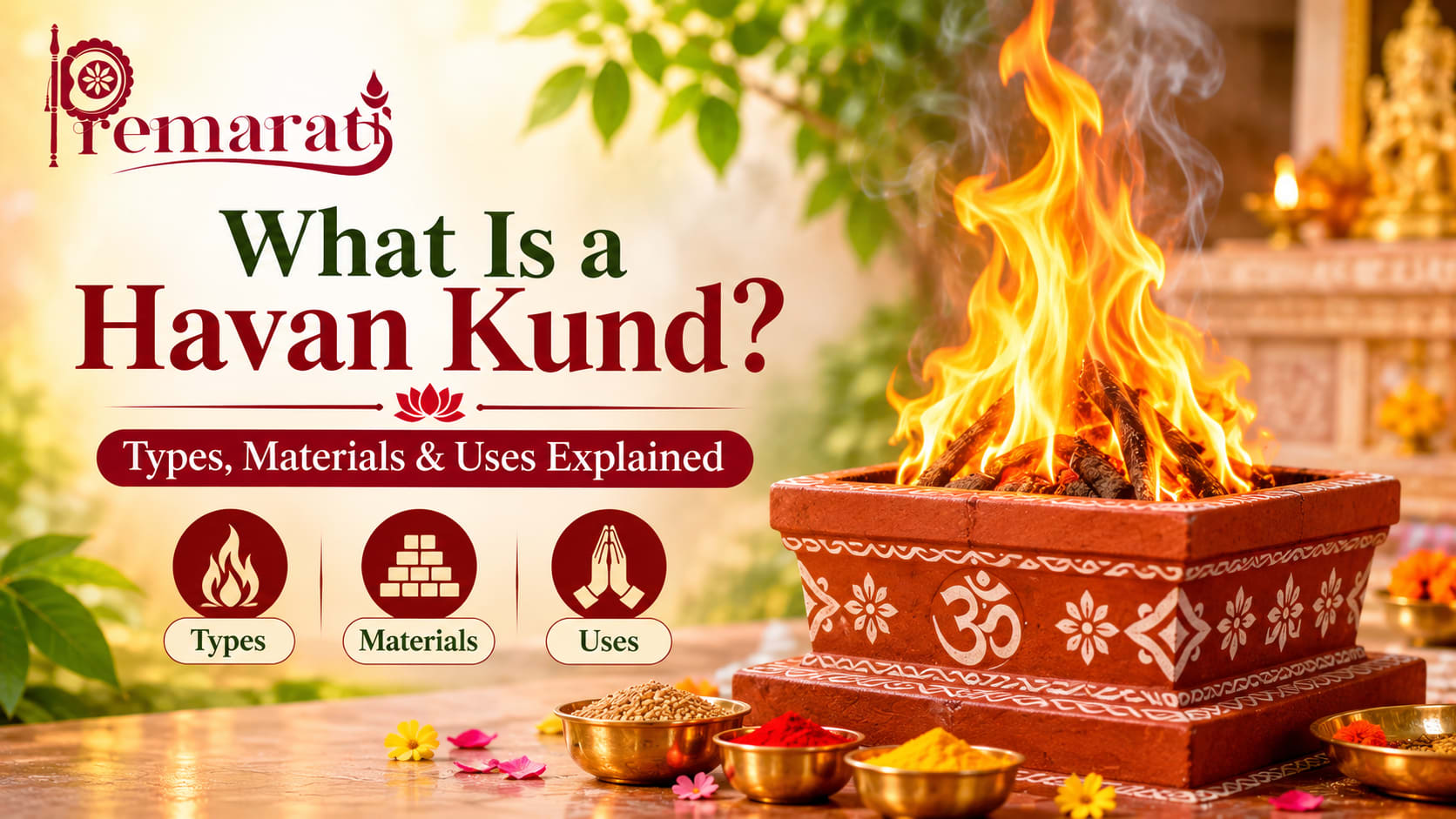
A havan kund is the vessel that holds the sacred fire in a havan, homa or yajna. This guide explains its common shapes and materials, how to choose a kund for a small home, what else you need for a havan, when families perform one, and simple steps and safety tips for lighting it.
What Is a Havan Kund? Types, Materials & Its Role!
Want to incorporate ancient wisdom into your spiritual routine? Fire, one of the oldest messengers known to us in Hindu tradition, has been an integral part of that history, and it all begins with the messenger's home: the havan kund. Have you ever considered what's required to make sure every fire is a holy fire? Well, look no further. As you prepare for your griha pravesh, shanti homa, or any party or yagna you're hosting, we'll get you up to speed on what a havan kund actually is, which one is perfect for you, and how to practice with it without worry.
Havan Kund in 30 Seconds
So, what's a havan kund? It's a vessel for fire that's typically a stepped, hollow pot, and it's meant to contain the holy fire during a Hindu fire ceremony, such as a havan, homa, or yajna.
Purpose: To contain the fire safely and to delineate the spaces of the ritual.
Common shapes: Square, circular, lotus, pyramid-style.
Common materials: Copper, brass, iron, clay, stone.
Size of the home: Small-sized kunds are suitable for small puja rooms and apartments.
Havan Kund – Not Just a Container
Here's the point: you can't just start a fire in any bowl. Ritual is about intention and order.
● The sacred fire is given a seat of its own, cleared of any rubbish.
● The wood, ghee and samagri are kept one after the other.
● With a well-organised space, you will be able to focus on your work.
● A quality vessel keeps floors, families and fires protected.
Havan Kund Types: Shape Speaks
Have you wondered where the merits of constructions are for Shivagurus of different lineages? Traditional texts describe kunds in different geometries, each with its symbolism. Beware! Be sure to ask your priest!
Chaturasra (square): Commonly associated with general homas and the most popular choice.
Vritta (circle): Associated with peace and well-being rites.
Yoni (womb-like curve): Associated with rituals for family and progeny.
Padma (lotus): Associated with prosperity and Lakshmi worship.
Stepped pyramid (inverted pyramid): A modern, compact option for home havan.
Material World: Which Kund Metal Wins?
Copper: Heat-friendly, traditional and widely preferred. It needs regular polishing.
Brass: Sturdy, elegant and long-lasting. It becomes heavy in larger sizes.
Iron: Tough enough for big, frequent fires. It can rust if left damp.
Clay or mud: Simple, earthy and eco-friendly. It is fragile and often single-use.
Brick or stone: Permanent and suited to large yajnas. It is not portable.
Havan Kund for Home: A 5-Point Buying Guide
Ever thought of performing an ancient ritual of havan at home? Then wonder what to look out for when choosing a havan kund? Here are a few points to keep in mind while making your choices. I live in a flat, so I need a small havan kund. Traditional kunds are tiered along the sides to keep the shape of the fire, so look out for this. A good base or tray helps place the fire in one place instead of on your floor. The difference a good finish makes: with a good finish, edges will be smooth, and you will be able to use a havan kund safely. And if you want to use it from one festival to another, then metal, for its reusability, makes it worth the investment.
Pro tip: If these havans happen once in a blue moon for you, go for a small copper/brass kund. It occupies less space, goes easy on time for cleaning, but still carries the essence of the tradition.
Havan Essentials Checklist
Once you have your kund, what else will you need for a havan? A kund is only the beginning. Here are some of the other things you'll need: a tray for your kund, dried mango wood sticks (samidha), a stainless steel container of pure ghee with a scooper, havan samagri and dhoop, a box of camphor to light your flame, a water container, a clean cloth, a box of matches, and a fire-proof mat.
Have you visited Premarati already? With their brass collection, mango wood sticks, pure ghee, dhoop and camphor, you can set up your ritual table conveniently in one shop.
When Do You Require One? Famous Havan Events
Griha pravesh: To bless a new home.
Satyanarayan Puja: To conclude worship with an offering.
Navagraha shanti: To seek planetary balance.
Navratri homa: To honour the Goddess.
Birthdays and anniversaries: To begin the year with gratitude.
Light It Right: 6 Easy Steps
Let's get this puja burning!
1. Place the kund on a flat, clean, non-curtained surface.
2. Fill the kund with fresh mango wood and light the camphor.
3. Keep the fire going with a simple prayer.
4. Say your mantras with each serving of ghee and samagri, and end them with Swaha
(pronounced: swa-ha). Rest the kund naturally when done; no need to splash water on it.
5. Once the panchgavya ash is cool, it can be safely salvaged.
Safety First: Havan Do's and Don'ts
Do:
Keep a bucket of sand nearby.
Use dry, clean wood.
Keep children at a safe distance.
Open a window for airflow.
Don’t:
Leave the fire unattended.
Use treated or painted wood.
Wear loose, flowing synthetic fabric.
Pour water on the flames.
Quick FAQs
Sick of havan outdoors? You can do a havan at home if you have proper ventilation and a small kund.
Which kund is good for the beginner? A kund with a square copper or brass shape is perfect.
How should it be cleaned? Once the ashes are entirely cold, use a cloth to clean the kund, and you can use a metal polishing cloth for polishing.
Ignite Your Sacred Space
A havan kund turns a flame into a prayer. Here's the thing: With the right shape, good-quality ingredients, and some essentials, your next fire puja can be more peaceful, more protected, and more sacred. Keen to learn more? Shop havan kunds and ritual must-haves from Premarati.